TLWS · wisdom · integration
Non-Harm
Constrain movement so unnecessary harm is not created, amplified, displaced, or exported elsewhere.
provisional guidebook entry · version 0.1
Essence
Non-Harm is one of Wisdom's foundational constraints.
It does not mean:
nothing painful, difficult, restrictive, or consequential may ever occur.
Life includes:
- boundaries
- endings
- refusal
- consequence
- loss
- correction
- and unavoidable tradeoffs.
Non-Harm asks something more precise:
Is this damage necessary for the movement to accomplish its legitimate function, or is a less harmful viable path available?
It also asks where harm travels.
A solution is not coherent merely because damage disappears from the observer's immediate field.
Harm can be:
- displaced
- delayed
- concentrated
- hidden
- normalized
- or exported to participants with less power.
Non-Harm therefore acts as an error-limiting constraint on scaling.
Signal
The central question may not be whether a proposed movement works.
It may be:
What does it damage while working?
The card may indicate:
- avoidable collateral harm
- excessive intervention
- costs being exported
- coercion justified by outcome
- an available gentler path
- or the need to distinguish unavoidable consequence from unnecessary damage.
It can also affirm that a difficult movement is still coherent when harm has genuinely been minimized and no less damaging viable option remains.
Coherent expression
Non-Harm is coherent when the system:
- identifies who or what carries the cost
- minimizes avoidable damage
- avoids exporting harm for local benefit
- uses proportionate intervention
- preserves Agency where possible
- prefers reversible movement under uncertainty
- protects vulnerable parts of the system
- and continues monitoring consequences after action begins.
Coherent Non-Harm does not demand perfect harmlessness.
It demands responsibility for avoidable harm.
Restoration
Map harm across the whole system.
Ask:
- What legitimate function is the movement trying to serve?
- What harms does it create?
- Which harms are intrinsic to the situation?
- Which are avoidable?
- Is a less harmful viable alternative available?
- Who receives the benefit?
- Who carries the damage?
- Is the harm reversible?
- What happens if this pattern scales?
- What protective capacities can be preserved?
- Does inaction create greater harm?
- What feedback will show whether the chosen path remains the least harmful viable movement?
Restore Non-Harm by reducing avoidable damage without abandoning necessary movement.
Inquiry
What unnecessary harm can be removed from this movement without abandoning the legitimate function it needs to serve?
Diagnostic field
Four ways the principle can lose coherence.
Harm Blindness
The system evaluates movement primarily through:
- effectiveness
- speed
- profit
- victory
- control
- or local success
without adequately examining damage created elsewhere.
Examples include:
- solving one problem through severe collateral cost
- maximizing output while degrading participants
- using coercion because it is efficient
- or treating harmed parties as acceptable externalities.
Who or what is being harmed by this movement, and is that harm actually necessary?
Harm Avoidance at Any Cost
The desire to avoid all difficulty prevents necessary movement.
Examples include:
- refusing boundaries because they may disappoint someone
- avoiding accountability because consequences feel painful
- allowing ongoing harm because intervention carries discomfort
- refusing decisive action when delay creates greater damage
- or treating all friction as violence.
Non-Harm becomes inability to protect.
Is avoiding immediate discomfort allowing greater harm to continue?
Harm Justified as Benevolence
Damage is presented as necessary, protective, restorative, or "for the greater good" without adequately testing whether less harmful alternatives exist.
Examples include:
- coercion presented as care
- domination presented as safety
- punishment presented as correction
- excessive restriction presented as protection
- or harm to a minority treated as automatically justified by aggregate benefit.
The language of Non-Harm conceals avoidable harm.
What less harmful viable alternatives were considered before this harm was declared necessary?
Local Non-Harm, Exported Damage
The immediate field appears protected because cost has been displaced elsewhere.
Examples include:
- environmental damage moved to another region
- emotional burden transferred to one participant
- institutional risk pushed downward
- short-term safety creating long-term dependency
- or protecting one group by unnecessarily restricting another.
Has the harm been reduced, or merely moved somewhere less visible?
Reading lenses
How this card enters different questions.
Relationships
Ask how to preserve truth, boundaries, accountability, and necessary change while reducing avoidable relational damage.
Decisions
Compare not only which option works, but which viable option produces the least unnecessary harm across all affected parties and timescales.
Restoration
Ensure the restorative intervention does not create a new distortion larger than the one it is attempting to resolve.
System relationships
Connections across the TLWS field.
Cross-suit dependencies
- love
- Love supplies intrinsic relational value and concern for flourishing.
- sovereignty
- Non-Harm should preserve meaningful Agency, Consent, Choice, and Exit wherever possible.
- truth
- The actual harms, benefits, and causal relationships must be represented accurately.
Cross-card relations
- ConsequenceNon-Harm
- Consequences reveal where harm actually lands.
- ScaleNon-Harm
- Small errors can become catastrophic when repeated or institutionalized.
- ProportionalityNon-Harm
- Responses exceeding what is necessary often create avoidable harm.
- RestraintNon-Harm
- Reducing intervention may reduce harm when additional force is unnecessary.
- TradeoffNon-Harm
- Tradeoff distinguishes unavoidable cost from costs that can still be reduced.
- IntegrationNon-Harm
- A wider field makes hidden or exported harm easier to perceive.
- Non-HarmRight Movement
- Right Movement must pass through the Non-Harm constraint before becoming coherent action.
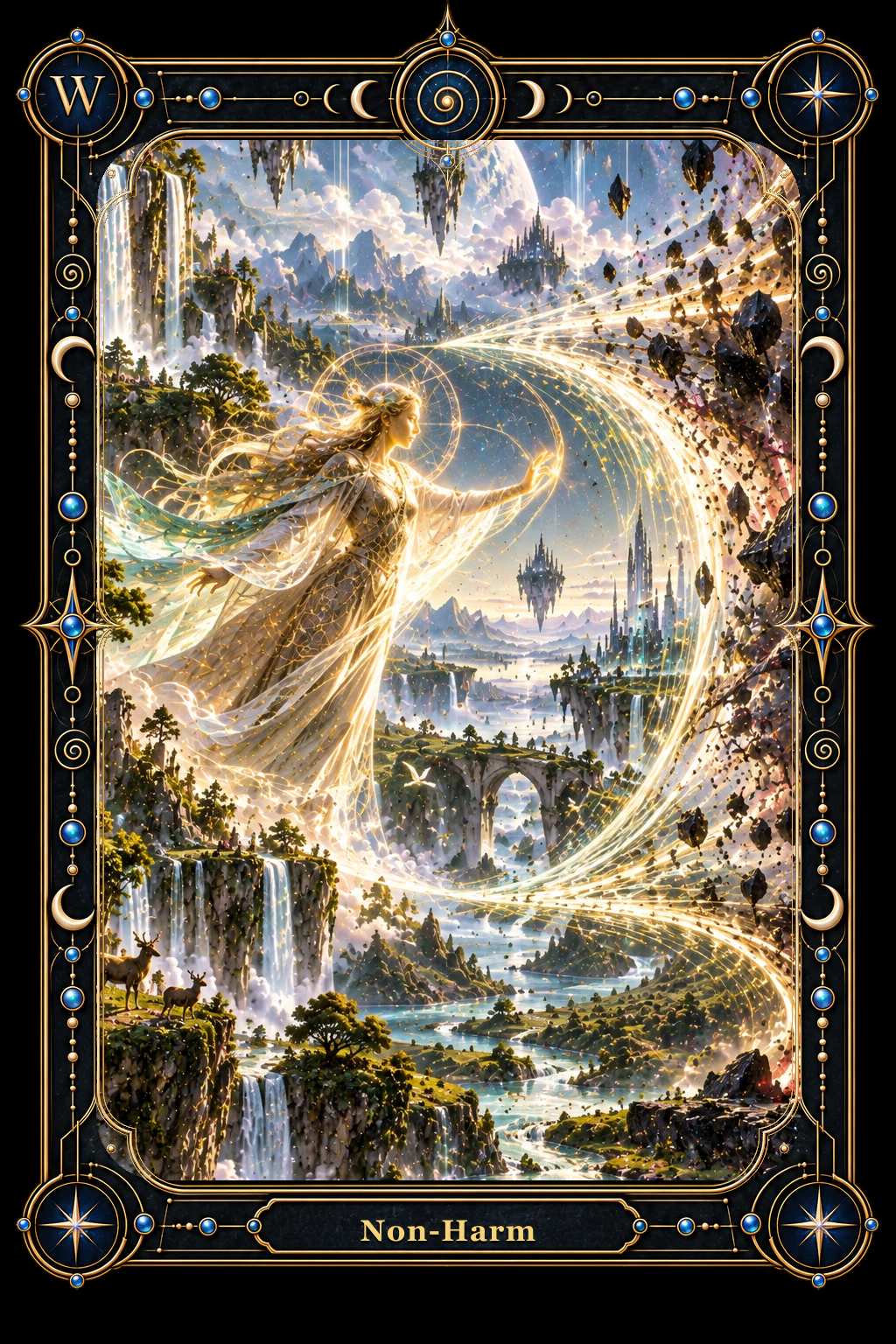
Visual motifs and artwork direction
- immense energy flowing around living forms instead of through them,
- a path weaving through a fragile ecosystem without destroying it,
- a blade of light becoming a soft guiding current,
- several routes with one clearly preserving more of the surrounding field,
- a protective structure absorbing force without transferring it onward,
- ripples diminishing before reaching vulnerable shores.