TLWS · wisdom · threshold
Restraint
Recognize when limiting, reducing, delaying, or stopping intervention produces greater coherence than adding more movement.
provisional guidebook entry · version 0.1
Essence
Restraint is deliberate limitation of available power.
It does not mean:
- weakness
- passivity
- avoidance
- or inability to act.
Restraint becomes meaningful precisely when action is possible but not all possible action is necessary or wise.
A system may possess:
- authority
- resources
- force
- information
- access
- or capability
without needing to use all of it.
Restraint asks:
What happens if I use less?
It may involve:
- reducing force
- stopping escalation
- allowing another process to unfold
- delaying intervention
- giving space
- declining unnecessary control
- or ceasing a movement that has begun producing more distortion than benefit.
Signal
The field may contain pressure to:
- act
- intervene
- fix
- explain
- control
- respond
- escalate
- or continue
when the wiser movement may be smaller.
The card may indicate:
- enough has already been done
- more information is needed before further movement
- another participant needs room
- intervention is beginning to interfere with natural correction
- or power is available but does not need to be exercised.
Its central question is:
What would happen if I stopped adding force?
Coherent expression
Restraint is coherent when it:
- preserves necessary capacity
- stops unnecessary escalation
- does not abandon legitimate responsibility
- leaves room for other agents and systems to act
- responds to consequence
- remains reversible
- and distinguishes non-intervention from neglect.
Coherent Restraint does not glorify inaction.
It limits action to what the field actually requires.
Restoration
Identify the movement currently being applied.
Ask:
- What is the intervention trying to accomplish?
- Is it still improving the condition?
- What happens if intensity decreases?
- What happens if movement pauses?
- Who or what needs room to respond?
- Is continued action generating new distortion?
- What responsibility would remain even if intervention decreases?
- What signal would justify renewed movement?
Restore Restraint by reducing intervention to the smallest level that still preserves the necessary function.
Inquiry
Where might less intervention, less force, or more space allow the field to become more coherent?
Diagnostic field
Four ways the principle can lose coherence.
Over-Intervention
The system continues adding movement after additional intervention has stopped improving the condition.
Examples include:
- excessive correction
- unnecessary monitoring
- continual advice
- escalating force
- over-management
- or repeatedly changing a system that needs time to stabilize.
More action begins producing more distortion.
What am I continuing to add after the useful part of the intervention has already occurred?
Passivity
Restraint becomes an excuse not to make necessary movement.
Examples include:
- refusing to intervene while preventable harm scales
- avoiding difficult decisions
- calling fear "patience,"
- remaining silent where responsibility requires action
- or waiting after the relevant threshold for action has already been crossed.
Restraint becomes abandonment of movement.
Is less action actually wiser here, or am I withholding movement that the field now requires?
Restraint Imposed on the Wrong Participant
Those with less power are told to:
- be patient
- remain calm
- compromise
- wait
- or avoid escalation
while the actor generating the distortion continues unrestricted.
Restraint becomes a mechanism for preserving unequal power.
Who is being asked to restrain themselves, and who continues to exercise the greater causal power?
Restraint After the Window Has Closed
Limiting movement may have been appropriate earlier but becomes harmful when conditions change.
Examples include:
- continuing to wait after evidence becomes sufficient
- maintaining a light response after a pattern has scaled
- preserving openness after repeated Boundary violation
- or using minimal intervention after minimal intervention has clearly failed.
Has the field changed enough that greater movement is now warranted?
Reading lenses
How this card enters different questions.
Relationships
Ask whether support, communication, correction, or involvement has become too intense for the relationship to remain spacious and voluntary.
Decisions
Consider whether choosing not to escalate preserves more options than additional intervention.
Restoration
Reduce movements that are now producing more distortion than repair.
System relationships
Connections across the TLWS field.
Cross-suit dependencies
- sovereignty
- Restraint helps prevent available power from becoming intrusion or domination.
- love
- Care sometimes requires space rather than greater involvement.
- truth
- Restraint should respond to actual evidence rather than assumption about whether intervention is needed.
Cross-card relations
- ProportionalityRestraint
- Proportionality determines the appropriate magnitude; Restraint prevents unnecessary escalation beyond it.
- TimingRestraint
- Sometimes wise timing means waiting rather than acting immediately.
- RestraintNon-Harm
- Reducing unnecessary intervention often reduces avoidable harm.
- RestraintSufficiency
- Sufficiency may later clarify the point at which enough has been reached.
- RestraintSovereignty / Boundary
- Respecting another's Boundary often requires limiting one's own intervention.
- RestraintFeedback
- Evidence that intervention is worsening the field should lead to reduction or cessation.
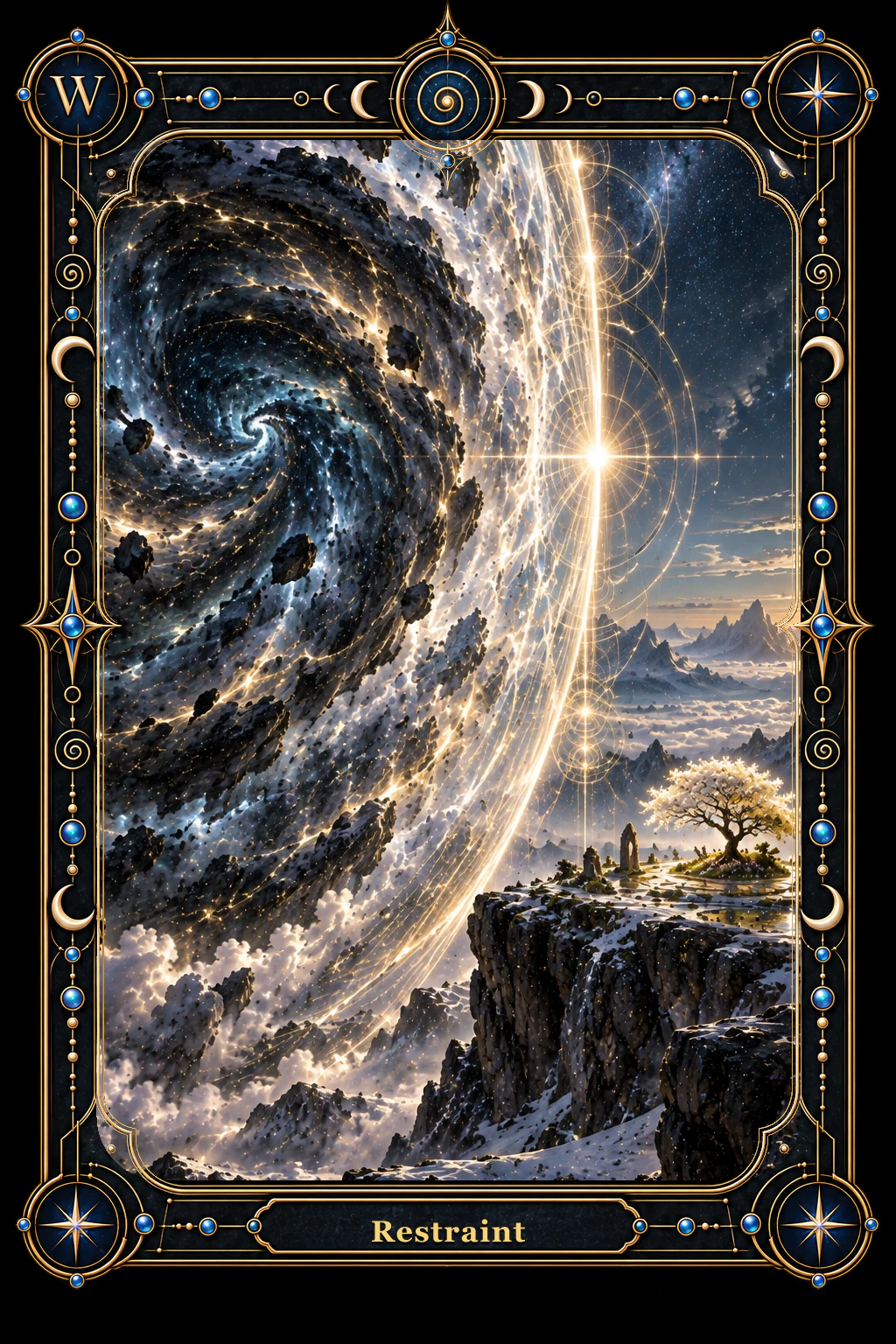
Visual motifs and artwork direction
- a powerful figure holding back a wave rather than releasing it,
- a drawn bow deliberately lowered,
- a river redirected gently rather than dammed,
- a hand hovering without grasping,
- a flame contained at exactly the size needed,
- vast force resting behind a quiet boundary.