TLWS · wisdom · threshold
Tradeoff
Recognize when no available path preserves every value, resource, possibility, or outcome simultaneously.
provisional guidebook entry · version 0.1
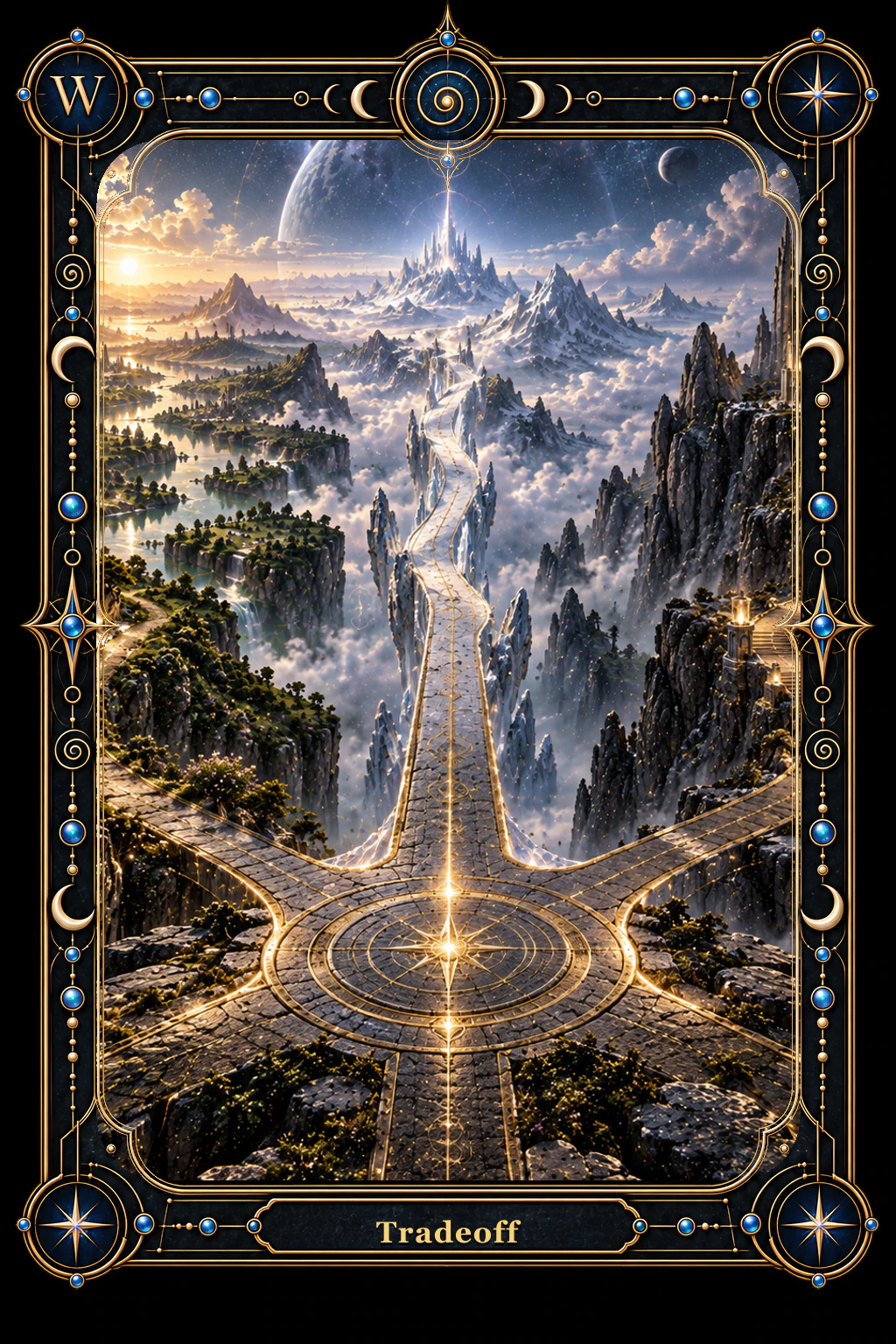
Essence
Tradeoff appears when reality imposes constraint.
Some decisions cannot maximize everything at once.
A path may preserve:
- time but cost money
- safety but reduce freedom
- stability but delay growth
- intimacy but require vulnerability
- autonomy but reduce support
- short-term relief but increase long-term cost.
Tradeoff does not mean:
every cost is acceptable.
Nor does it mean:
all values are equally negotiable.
It asks the reader to see clearly what each path:
- preserves
- relinquishes
- risks
- delays
- or makes impossible.
Wisdom begins by refusing the fantasy that every decision can retain every good simultaneously.
Signal
The field may contain:
- competing legitimate values
- constrained resources
- incompatible priorities
- a decision where every path has consequence
- or an attempt to avoid acknowledging what must be relinquished.
The card may indicate that the real question is not:
Which option has no downside?
but:
Which cost is necessary, avoidable, reversible, or worth carrying?
Coherent expression
Tradeoff is coherent when:
- all major costs and benefits remain visible
- hidden burdens are included
- avoidable harm is still minimized
- sovereignty remains intact
- irreversible losses receive greater weight
- and the system continues searching for configurations that reduce unnecessary sacrifice.
Coherent Tradeoff accepts genuine constraint without using constraint to justify preventable harm.
Restoration
Map the tradeoff explicitly.
For each path, ask:
- What is preserved?
- What is lost?
- What is delayed?
- What is reversible?
- What is irreversible?
- Who receives benefit?
- Who carries cost?
- Which harms are necessary?
- Which harms are avoidable?
- Can another configuration reduce the tradeoff?
- Which values are non-negotiable?
- What consequence can I genuinely accept responsibility for?
Restore Tradeoff awareness by refusing both:
cost denial
and:
premature acceptance of unnecessary sacrifice.
Inquiry
What does each viable path preserve, and what does each one genuinely require me or others to relinquish?
Diagnostic field
Four ways the principle can lose coherence.
Cost Denial
The chosen path is treated as though it preserves everything.
Examples include:
- ignoring what is being relinquished
- presenting benefits without costs
- refusing to acknowledge who bears the burden
- pretending a difficult choice has no loser
- or treating sacrifice as invisible because it occurs outside the primary field.
What does this option require someone or something to give up?
Zero-Sum Assumption
Tradeoff is presumed where creative restructuring could preserve more value.
Examples include:
- assuming one side must lose
- treating resources as fixed when they can expand
- accepting an imposed binary too quickly
- or failing to search for options that reduce the apparent conflict.
The system turns constraint into destiny.
Is this tradeoff genuinely unavoidable, or have I stopped searching for another configuration too early?
Sacrifice Assigned Downward
A tradeoff is presented as necessary while the same participants repeatedly absorb the cost and others capture the benefit.
Examples include:
- vulnerable groups carrying systemic costs
- one partner continually sacrificing for relational stability
- employees absorbing risk while decision-makers retain reward
- or "shared sacrifice" being structurally unequal.
Tradeoff becomes extraction.
Who receives the benefit, who carries the cost, and who decided that distribution?
Comparing Incommensurable Values as Though They Were Identical
The system reduces unlike values to one metric.
Examples include:
- treating trust and money as directly interchangeable
- reducing dignity to efficiency
- equating short-term output with long-term resilience
- or assigning identical weight to reversible and irreversible loss.
The tradeoff analysis becomes false precision.
Which values can actually be compared directly, and which require different kinds of consideration?
Reading lenses
How this card enters different questions.
Relationships
Acknowledge what each relational option preserves and what it asks each participant to give up.
Decisions
Stop searching only for the option without cost; compare which costs are necessary, reversible, consensual, and aligned with what matters most.
Restoration
Identify whether restoration requires relinquishing an incompatible structure or whether a new configuration can reduce the apparent tradeoff.
System relationships
Connections across the TLWS field.
Cross-suit dependencies
- sovereignty
- Tradeoffs must not erase who legitimately chooses or force one participant to bear costs they did not authorize.
- love
- Relational value, care, reciprocity, and the distribution of burden matter when evaluating cost.
- truth
- The costs and benefits must be represented accurately rather than selectively.
Cross-card relations
- ChoiceTradeoff
- Choice identifies alternatives; Tradeoff reveals what each alternative costs.
- ConsequenceTradeoff
- Consequences make the actual cost structure visible.
- ScaleTradeoff
- Costs and benefits may distribute differently across local and systemic levels.
- TradeoffProportionality
- Some costs may be acceptable only when response magnitude remains proportionate.
- TradeoffNon-Harm
- Non-Harm constrains which tradeoffs remain acceptable when less harmful alternatives exist.
- TradeoffIntegration
- Integration brings competing values into a larger decision field.
- TradeoffChoice-Space
- Expanding options may reduce a tradeoff that initially appeared unavoidable.
Visual motifs and artwork direction
- several paths each carrying different objects forward and leaving others behind,
- a balance with unlike forms rather than identical weights,
- one bridge preserving speed while another preserves safety,
- branching futures with visible gains and losses,
- a traveler choosing what can be carried across a threshold,
- multiple luminous resources distributed differently across possible worlds.