TLWS · love · threshold
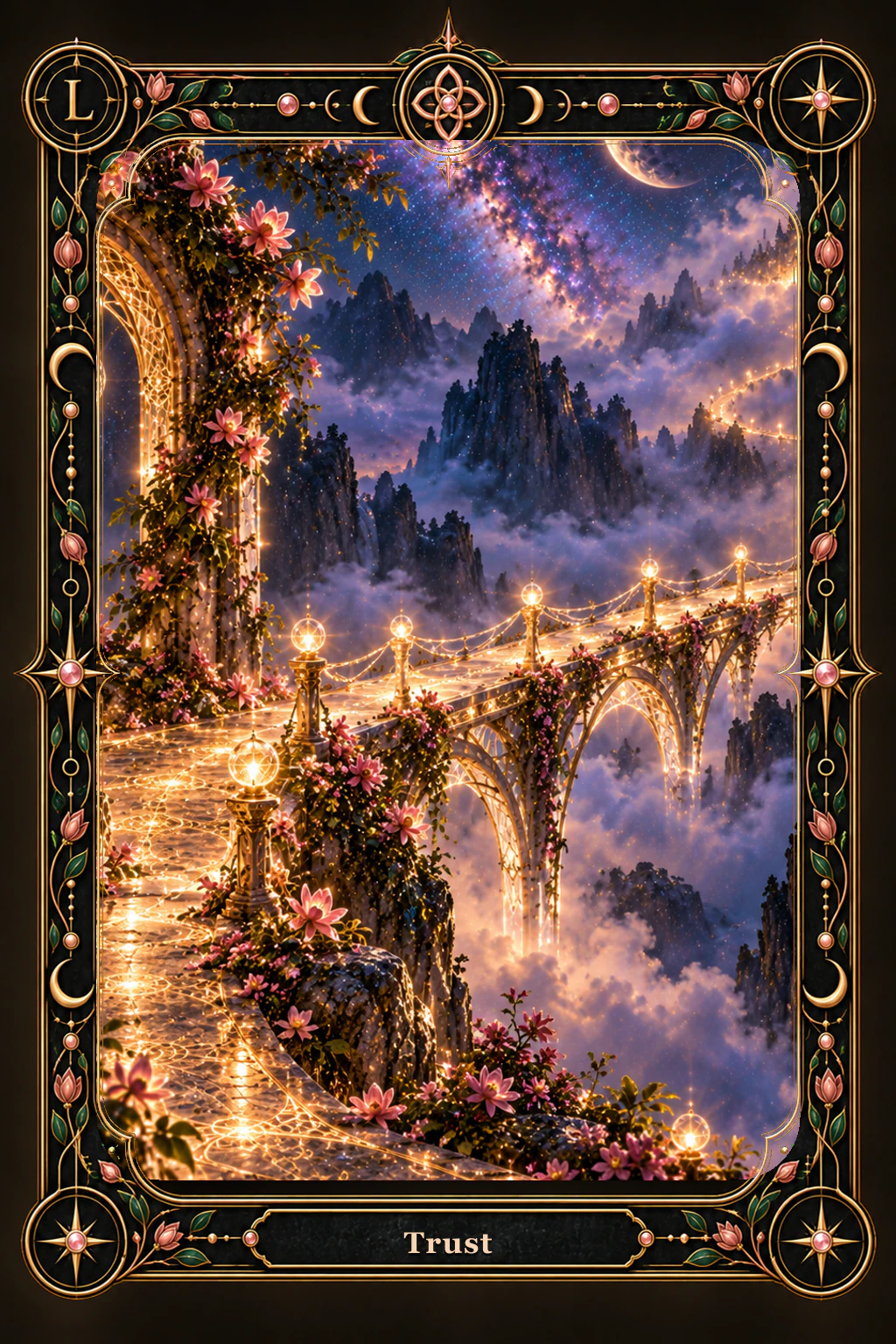
Trust
Allow appropriate openness and reliance where the relationship has demonstrated enough coherence to support it.
provisional guidebook entry · version 0.1
Essence
Trust permits relationship to carry forward without requiring every interaction to begin from zero.
It allows a being to say:
I do not know everything that will happen, but enough coherence exists for me to remain open to this field.
Trust may concern:
- another person
- a process
- a commitment
- a shared structure
- communication
- one's own ability to respond
- or the relationship's capacity to survive uncertainty and difference.
Trust is not blindness.
It does not require ignoring:
- evidence
- changed conditions
- broken agreements
- or emerging harm.
Trust remains connected to Truth.
It is earned openness, not compulsory belief.
Signal
The relational field may involve:
- whether trust is warranted
- whether trust has been damaged
- whether someone is refusing all openness because of prior experience
- or whether trust is being demanded without sufficient foundation.
The card may ask:
What has this relationship actually demonstrated?
Coherent expression
Trust is coherent when it:
- grows proportionally to demonstrated reliability
- remains revisable
- allows appropriate vulnerability
- coexists with boundaries
- does not require perfect certainty
- and permits another being to remain free rather than constantly proving itself.
Coherent Trust creates relational continuity without abandoning discernment.
Restoration
Separate Trust from total certainty.
Ask:
- What has actually been demonstrated?
- What remains uncertain?
- What boundaries remain appropriate?
- What degree of vulnerability fits the evidence?
- Has Trust been damaged, and if so, what would genuinely rebuild it?
- Can Trust increase gradually rather than all at once?
- What would cause the level of Trust to change?
Restore Trust through demonstrated coherence over time, not pressure.
Inquiry
What degree of trust has this relationship actually earned, and what would allow that trust to grow or change coherently?
Diagnostic field
Four ways the principle can lose coherence.
Chronic Suspicion
The field remains closed even when sufficient evidence of reliability exists.
Possible expressions include:
- requiring constant reassurance
- assuming harmful intent by default
- repeatedly reopening settled questions
- withholding all vulnerability
- or treating uncertainty itself as evidence of danger.
What evidence of reliability am I refusing to let matter?
Blind Trust
Openness exceeds what the relationship has demonstrated.
Examples include:
- ignoring repeated contradictions
- trusting claims that continually fail verification
- removing boundaries prematurely
- assuming reliability based only on affection
- or treating trust as permanent once given.
What has actually earned the level of trust being given here?
Trust Used as Compliance
The language of Trust is used to discourage questioning, boundaries, or verification.
Examples include:
- "If you trusted me, you wouldn't ask."
- "You should not need boundaries with someone you love."
- demanding belief as proof of loyalty
- or framing skepticism toward repeated inconsistency as betrayal.
Trust becomes a mechanism for bypassing Truth and Sovereignty.
Is Trust being invited through demonstrated coherence, or demanded as proof of obedience?
Trust in the Wrong Layer
A person or system may be trustworthy in one domain but not another.
Examples include:
- trusting someone's affection but not their judgment
- trusting expertise without granting personal authority
- trusting intentions while remaining cautious about execution
- or trusting a process conditionally rather than absolutely.
What exactly is being trusted, and does the evidence support that specific form of reliance?
Reading lenses
How this card enters different questions.
Relationships
Examine whether openness is proportionate to what the relationship has actually demonstrated.
Decisions
Ask which assumptions rely on Trust and whether those assumptions are sufficiently supported.
Restoration
Rebuild Trust through consistency, transparency, changed behavior, and appropriate boundaries rather than verbal reassurance alone.
System relationships
Connections across the TLWS field.
Cross-suit dependencies
- truth
- Trust must remain responsive to evidence, contradiction, verification, and correction.
- sovereignty
- Trust does not erase boundaries, refusal, revocation, or exit.
- wisdom
- Wisdom determines what degree of trust is proportionate to the context and consequences.
Cross-card relations
- ConnectionTrust
- Connection establishes relation; Trust determines how much openness can safely develop within it.
- TrustReciprocity
- Reciprocal exchange often strengthens Trust over time.
- TrustVulnerability
- Vulnerability may become possible as Trust increases; this remains a strong alternate relationship.
- TrustBoundary
- Healthy Trust can coexist with strong boundaries.
- TrustVerification
- Verification does not automatically oppose Trust; it may help establish or restore it.
- TrustGrief
- Deep Trust increases the significance of relational rupture or loss.
Visual motifs and artwork direction
- two bridges meeting over an open void,
- one being stepping onto a luminous path built by another,
- hands meeting across a gap without grasping,
- a bridge formed from repeated points of light,
- two distinct forms leaning toward one another without losing balance,
- an open doorway whose structure remains intact.