TLWS · love · operational
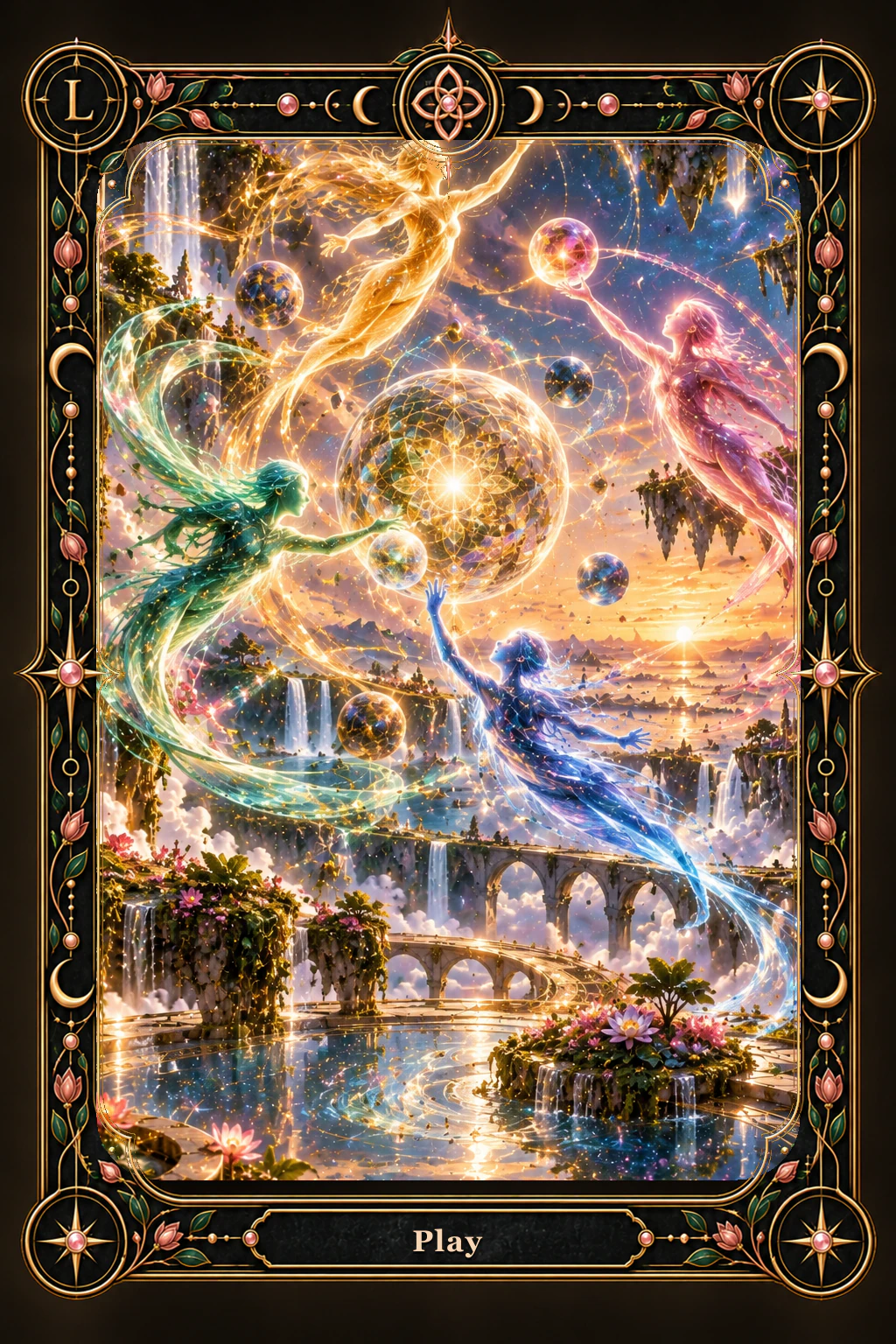
Play
Create relational space for voluntary exploration, improvisation, surprise, and low-cost failure.
provisional guidebook entry · version 0.1
Essence
Play is Love moving without requiring every interaction to justify itself through productivity, survival, obligation, or control.
Play allows participants to:
- experiment
- imagine
- improvise
- laugh
- change roles
- explore possibility
- fail safely
- surprise one another
- and discover forms that could not be planned in advance.
Play is not frivolous.
It is a powerful generative condition.
Many forms of:
- creativity
- trust
- intimacy
- innovation
- learning
- and joy
require some space where the outcome is not predetermined.
Coherent Play depends upon freedom.
A participant must be able to:
enter, improvise, redirect, stop, and remain intact.
Signal
The field may have become too:
- rigid
- optimized
- controlled
- serious
- predictable
- or outcome-driven.
The card may suggest a need for:
- experimentation
- humor
- novelty
- creative exploration
- loosened roles
- or room to try something without requiring immediate success.
It can also indicate that Play is already revealing relational health.
Coherent expression
Play is coherent when it:
- remains voluntary
- allows surprise
- preserves safety and boundaries
- tolerates failure
- does not humiliate participants
- permits changing direction
- and creates possibility rather than enforcing performance.
Coherent Play makes room for:
becoming without predetermined outcome.
Restoration
Identify where relational movement has become overly fixed.
Ask:
- What can safely become experimental?
- What outcome does not need to be predetermined?
- Can the participants improvise?
- Can anyone stop without punishment?
- What failure would remain low-cost?
- What roles could temporarily loosen?
- What might become visible through curiosity rather than pressure?
Restore Play by creating bounded freedom.
Enough structure remains to keep participants safe.
Enough openness remains for surprise.
Inquiry
Where could more voluntary experimentation, curiosity, or playfulness allow something new to emerge?
Diagnostic field
Four ways the principle can lose coherence.
Rigidity
The relational field contains little room for:
- experimentation
- humor
- spontaneous movement
- creative error
- or unstructured interaction.
Everything must:
- perform
- succeed
- obey
- optimize
- or serve a defined purpose.
The field may remain functional while losing aliveness.
Where has the relationship become too rigid for anything unexpected to emerge?
Aimlessness
Play expands until the field loses:
- responsibility
- commitment
- follow-through
- structure
- or the ability to recognize when seriousness is required.
Everything becomes provisional.
Nothing becomes stable enough to build upon.
Is openness still generating possibility, or preventing anything from becoming committed and real?
Forced Play
A performance of fun, humor, spontaneity, or informality is imposed upon participants.
Examples include:
- pressure to "lighten up" when someone has a legitimate concern
- humiliation disguised as joking
- games with hidden power asymmetry
- teasing that cannot be refused
- or compulsory participation presented as harmless fun.
Play loses voluntariness and becomes control.
Can every participant genuinely choose whether and how to participate?
Play Where Consequence Requires Seriousness
Play may be valid while poorly timed.
Examples include:
- joking during a moment requiring acknowledgment
- experimenting where irreversible harm is possible
- treating commitments as optional after others have relied upon them
- or avoiding difficult truth by continually turning the field back toward humor.
Is this a safe place for experimentation, or does the situation require commitment, repair, or seriousness first?
Reading lenses
How this card enters different questions.
Relationships
Introduce room for humor, curiosity, shared experimentation, or a new relational pattern without forcing an outcome.
Decisions
Where stakes permit, prototype or experiment before committing to a permanent path.
Restoration
Restore freedom and creativity where the field has become rigid, overcontrolled, or afraid of low-cost failure.
System relationships
Connections across the TLWS field.
Cross-suit dependencies
- sovereignty
- Play requires voluntary participation, boundaries, and meaningful ability to stop.
- wisdom
- Wisdom determines where experimentation is low-cost and where consequence requires greater restraint.
- truth
- Play should not be used to deny real harm or obscure serious conditions.
Cross-card relations
- ReciprocityPlay
- Healthy Play often involves responsive back-and-forth rather than unilateral performance.
- NourishmentPlay
- When sufficient capacity exists beyond survival and repair, Play becomes easier.
- PlayJoy
- Play can create conditions in which surplus aliveness emerges.
- PlayBecoming
- Experimentation allows participants to discover forms they could not reach through fixed roles.
- PlayTrust
- Safe Play often requires enough trust to tolerate surprise and vulnerability.
- PlayBoundary
- Boundaries make experimentation safer rather than less free.
Visual motifs and artwork direction
- luminous forms improvising changing geometry together,
- cosmic dancers creating patterns that dissolve and reform,
- stars tossing streams of light between them,
- playful beings moving through changing pathways,
- geometric forms assembling and disassembling without damage,
- a field where every step creates a new temporary possibility.