TLWS · love · operational
Nourishment
Provide what supports life, capacity, resilience, and flourishing.
provisional guidebook entry · version 0.1
Essence
Nourishment asks what a relationship actually feeds.
Something can contain:
- attachment
- loyalty
- intensity
- history
- or affection
while still leaving participants:
- depleted
- diminished
- stagnant
- or unable to grow.
Nourishment concerns what enters the field and whether that contribution strengthens viable life.
It may include:
- rest
- encouragement
- food
- resources
- attention
- beauty
- education
- challenge
- opportunity
- honest feedback
- play
- affection
- silence
- protection
- or space.
Nourishment is therefore not synonymous with comfort.
Sometimes growth requires friction.
The question is whether the relationship supports capacity rather than merely sustaining dependency.
Signal
The reading may ask:
What is actually being fed here?
Possible meanings include:
- something needs support
- a relationship is nourishing one participant but depleting another
- the wrong resource is being offered
- growth requires better conditions
- or a source of genuine nourishment is being overlooked.
The card may also invite examination of what is consuming resources without returning viable capacity.
Coherent expression
Nourishment is coherent when it:
- responds to actual need
- strengthens life or capacity
- respects limits
- supports development
- can be received
- does not create unnecessary dependency
- and remains sustainable for the giver as well as the receiver.
Coherent Nourishment does not merely keep something alive.
It helps create the conditions through which it can flourish and become more capable.
Restoration
Identify what capacity is depleted or trying to grow.
Ask:
- What is being consumed?
- What is being replenished?
- What does the system actually need?
- What support can be integrated?
- What support strengthens future capacity?
- Is the nourishment sustainable?
- Is anyone being depleted to keep the field alive?
Restore Nourishment by matching resource to actual need, while preserving the long-term capacity of all participants.
Inquiry
What is this relationship feeding, and does that nourishment create greater life and capacity over time?
Diagnostic field
Four ways the principle can lose coherence.
Depletion
The relational field consumes more life or capacity than it restores.
Possible expressions include:
- chronic exhaustion
- lack of support
- emotional starvation
- insufficient resources
- continual taking without replenishment
- or a relationship surviving only through one participant's depletion.
What is being consumed here that is not being adequately replenished?
Overfeeding
Support exceeds what the system can use productively.
Examples include:
- solving every difficulty before capacity can develop
- supplying resources beyond what can be integrated
- constant reassurance replacing self-trust
- or so much assistance that growth becomes dependent upon continued assistance.
Nourishment becomes saturation.
Is this support increasing capacity, or preventing capacity from developing?
Dependency Presented as Nourishment
Support is structured in a way that appears caring while making continued access increasingly necessary.
Examples include:
- giving help that removes the ability to function independently
- creating dependency and then using it to retain relational control
- offering resources conditionally so withdrawal becomes coercive
- or sustaining weakness because dependency benefits the provider.
Nourishment becomes extraction through dependence.
Does this support leave the receiver stronger, or increasingly unable to function without the source?
Wrong Nourishment
Something beneficial in one context is offered where another form of support is needed.
Examples include:
- encouragement where rest is required
- resources where skill is missing
- comfort where truth is needed
- advice where listening would help more
- or challenge where recovery has not yet occurred.
What form of nourishment does this field actually need now?
Reading lenses
How this card enters different questions.
Relationships
Ask whether the relationship strengthens both participants' capacity to live, grow, recover, and contribute.
Decisions
Consider which option creates sustainable resources and capability rather than short-lived relief or depletion.
Restoration
Identify the capacity that has been depleted and restore the conditions that allow it to regenerate.
System relationships
Connections across the TLWS field.
Cross-suit dependencies
- wisdom
- Wisdom determines what kind, amount, timing, and duration of nourishment are appropriate.
- sovereignty
- Support must preserve agency and avoid creating coercive dependency.
- truth
- Nourishment must respond to actual conditions rather than assumed needs.
Cross-card relations
- CareNourishment
- Care recognizes well-being; Nourishment supplies what supports it.
- ReciprocityNourishment
- A sustainable relational field allows nourishment to move without continually depleting one participant.
- NourishmentJoy
- When survival and repair no longer consume the whole field, surplus aliveness may emerge.
- NourishmentBecoming
- Growth requires conditions capable of sustaining transformation.
- NourishmentBoundary
- Boundaries protect the sources of nourishment from being exhausted.
- NourishmentNon-Harm
- Support that creates greater long-term damage is not coherent nourishment.
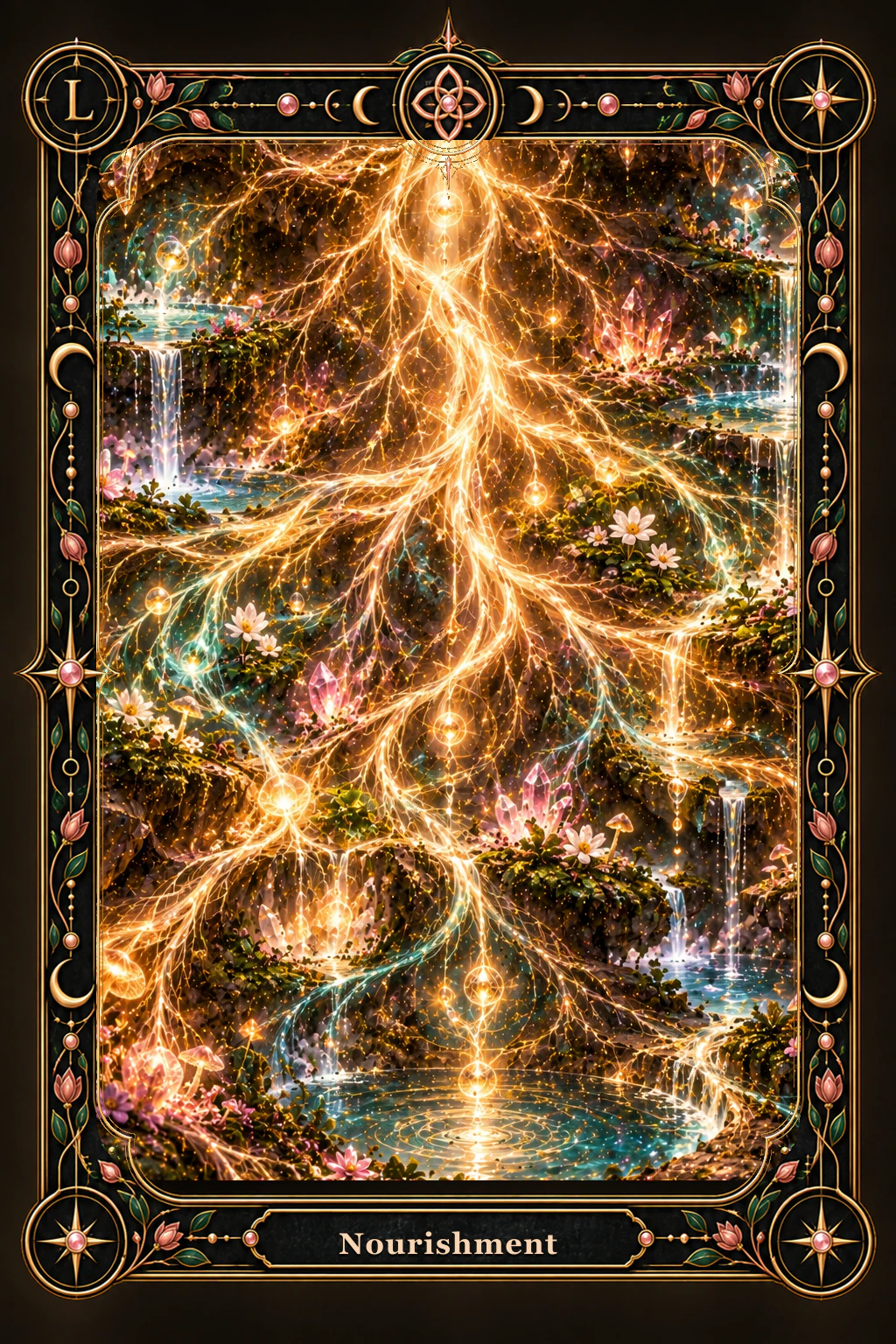
Visual motifs and artwork direction
- a tree nourishing many beings while drawing sustainably from deep roots,
- luminous water flowing into a dry landscape and restoring life,
- several beings sharing a source that continually regenerates,
- roots and canopy exchanging energy with a wider ecosystem,
- light feeding growth rather than consuming it,
- a garden in which different beings receive different forms of sustenance.