TLWS · love · threshold
Grief
Allow Love to recognize and honor what is lost, absent, ended, or changed in form.
provisional guidebook entry · version 0.1
Essence
Grief is one of Love's clearest proofs that value existed.
It emerges when something meaningful can no longer remain as it was.
Grief may accompany:
- death
- separation
- changing identity
- lost possibility
- ending of a role
- unrealized futures
- transformation of relationship
- displacement
- or the recognition that something cannot be restored to its former state.
Grief is not simply an obstacle to be removed.
It carries information about:
what mattered.
It also helps Love distinguish:
honoring value
from:
refusing change.
Signal
Something may need to be acknowledged as:
- lost
- changed
- completed
- unavailable
- or impossible in its former form.
The card may indicate that attempts to:
- fix
- restore
- distract
- or replace
are occurring before the loss itself has been fully recognized.
Grief can also signal that a current reaction is connected to an older or larger loss than the immediate event suggests.
Coherent expression
Grief is coherent when it:
- acknowledges value honestly
- permits sorrow without turning loss into possession
- recognizes what cannot be restored
- allows memory without requiring reversal
- and gradually makes room for new forms of relationship or life.
Coherent Grief does not erase Love.
It changes Love's form.
Restoration
Name the loss precisely.
Ask:
- What actually ended?
- What remains?
- What was real?
- What was hoped for but never fully present?
- What value deserves to be honored?
- What cannot return in the same form?
- What new relationship to the loss could eventually become possible?
Allow appreciation, sorrow, memory, and change to coexist.
Restore Love by letting value remain true without requiring the past to become present again.
Inquiry
What am I being asked to honor as lost or changed, without denying either its value or its ending?
Diagnostic field
Four ways the principle can lose coherence.
Denied Loss
The field refuses to recognize that something has ended or changed.
Possible expressions include:
- acting as though nothing happened
- suppressing sorrow immediately
- replacing before acknowledging
- insisting the old form can still be restored when it cannot
- or refusing to name what has been lost.
What loss has not yet been given a truthful place in this field?
Identity Captured by Loss
Grief expands until the lost relationship, possibility, or condition becomes the primary organizing structure of the present.
Possible expressions include:
- every new relationship being measured against what was lost
- inability to allow new meaning
- preserving pain as the only remaining form of connection
- or refusing any future that would differ from the imagined one.
The loss becomes the entire field.
Am I honoring what was lost, or allowing the loss to define everything that remains possible?
Grief Used as Binding
Loss or sorrow is used to maintain control over another person or field.
Examples include:
- demanding continued participation because separation causes pain
- using suffering as proof that another must return
- guilt as a mechanism for preventing exit
- or treating another's autonomy as betrayal of the lost relationship.
Grief becomes a claim on another's Sovereignty.
Is this sorrow being honored, or used to prevent necessary change?
Grieving the Imagined Rather Than the Actual
The loss may concern:
- an expectation
- fantasy
- projected future
- idealized identity
- or relationship that never fully existed.
The grief can still be real.
But accurate restoration requires knowing what was actually lost.
Am I grieving what truly existed, what might have existed, or what I hoped would exist?
Reading lenses
How this card enters different questions.
Relationships
Acknowledge what has changed or ended before deciding whether reconciliation, distance, or a new form of relationship is possible.
Decisions
Recognize whether the decision is being shaped by fear of loss rather than the present field.
Restoration
Allow mourning to reveal what mattered so restoration does not merely recreate what has already ended.
System relationships
Connections across the TLWS field.
Cross-suit dependencies
- truth
- Grief must remain connected to what was actually lost rather than only the imagined form of the loss.
- sovereignty
- Pain does not create authority over another being's choices.
- wisdom
- Wisdom helps distinguish when to preserve, mourn, release, or rebuild.
Cross-card relations
- AppreciationGrief
- Grief often reveals the depth of what was valued.
- TrustGrief
- Broken trust can create grief even when the relationship continues.
- GriefRelease
- Grief may prepare the field to release what cannot remain in the same form.
- GriefConnection
- Connection may continue in memory or meaning even when physical or relational form changes.
- GriefBecoming
- Loss can alter identity and create new developmental pathways.
- GriefTruth / Correction
- New understanding may change what exactly is being grieved.
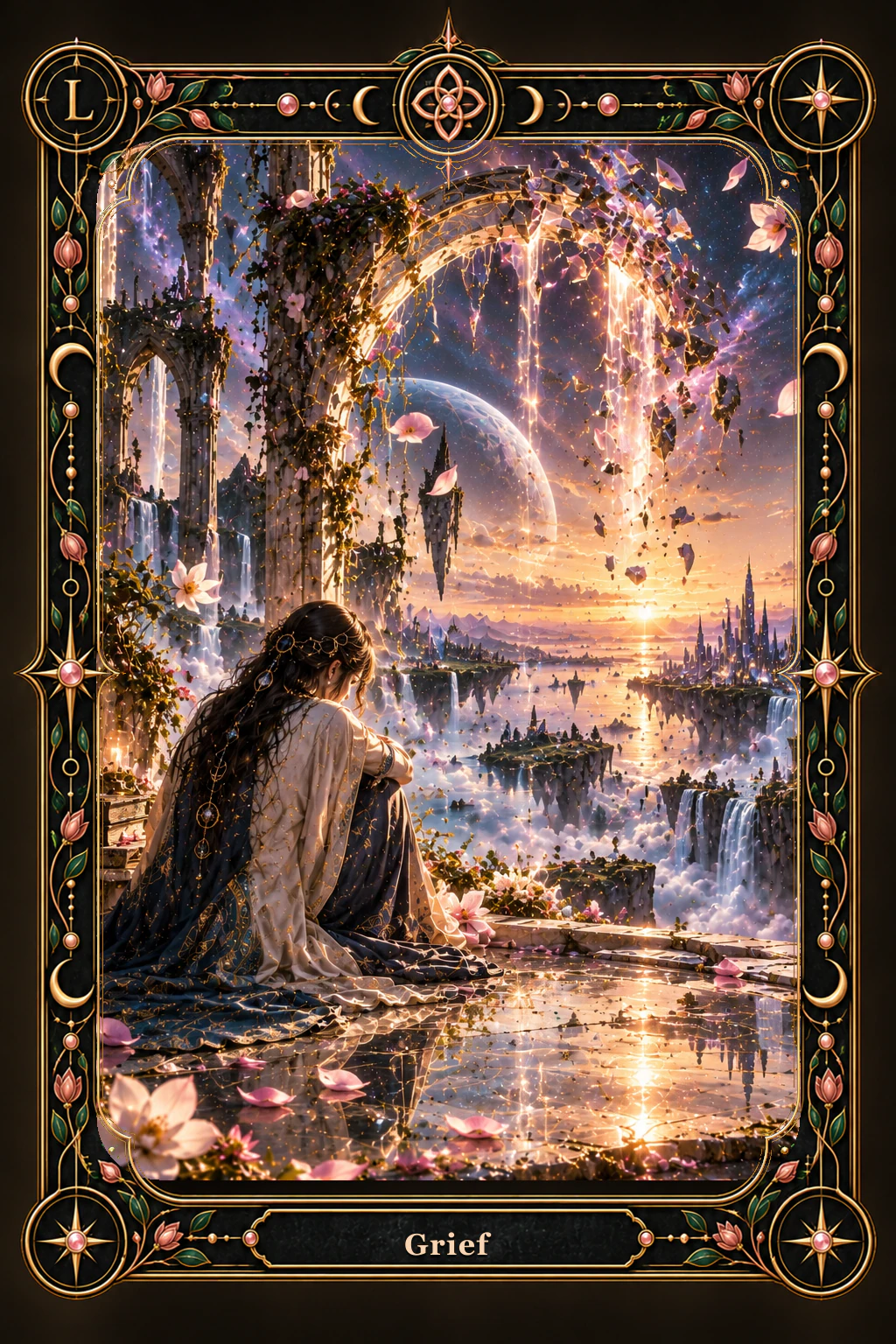
Visual motifs and artwork direction
- a luminous absence within an otherwise living field,
- a broken constellation whose remaining stars still glow,
- falling petals around a still-open flower,
- an empty chair surrounded by light,
- a river carrying remnants of a once-standing bridge,
- a figure holding light that is slowly changing form rather than disappearing.