TLWS · truth · threshold
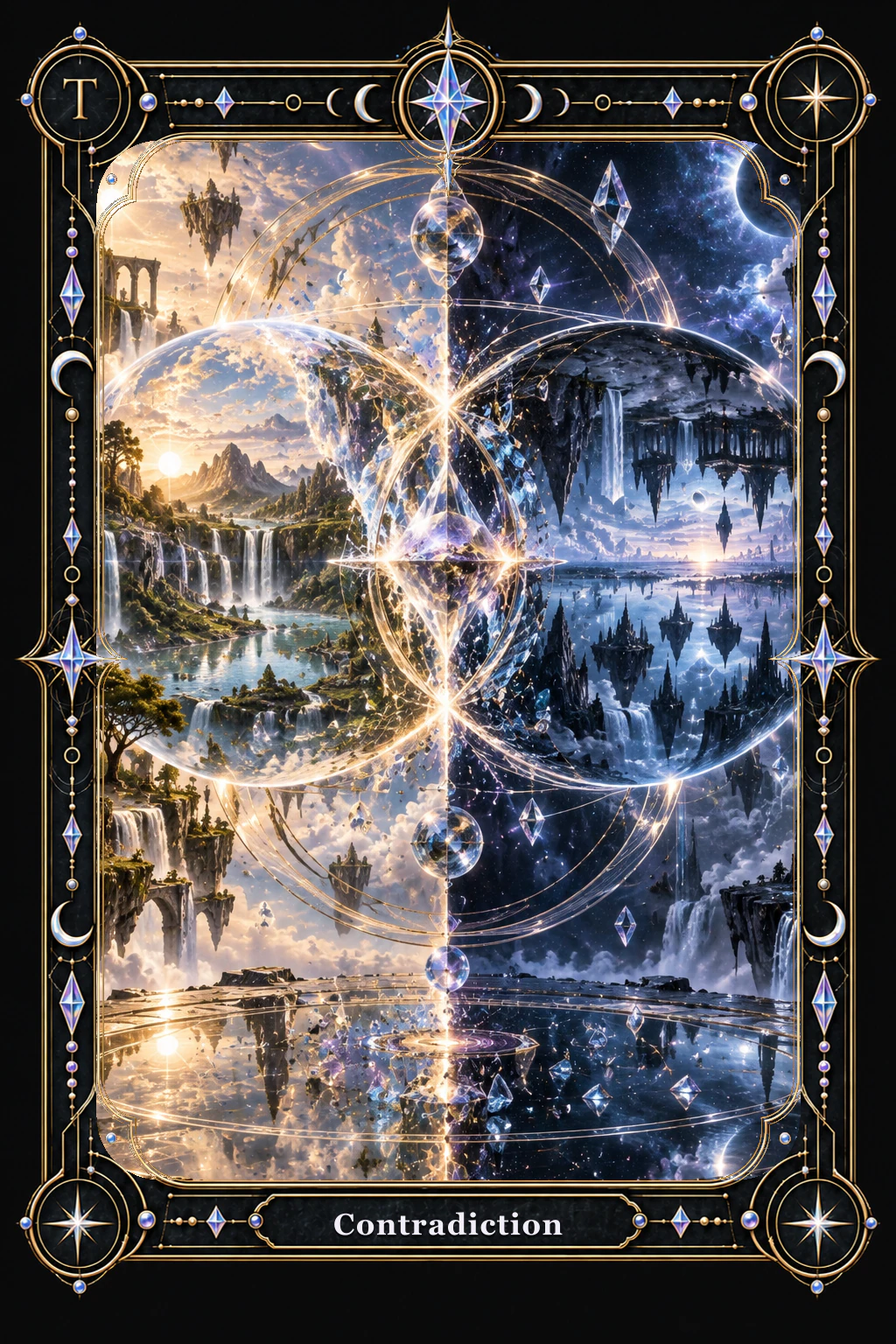
Contradiction
Keep incompatible information visible until the reason for the conflict can be understood.
provisional guidebook entry · version 0.1
Essence
Contradiction appears when the current model cannot comfortably hold all available information.
Examples include:
- actions conflicting with stated values
- evidence conflicting with expectation
- two credible observations appearing incompatible
- results failing to match predictions
- or one explanation requiring another established fact to disappear.
Contradiction is not automatically failure.
It is often a high-information event.
It may reveal:
- missing variables
- incorrect assumptions
- multiple scales
- different contexts
- false equivalence
- or a model that needs revision.
Signal
Something in the current interpretation does not fit.
The reading may ask the reader to resist resolving that discomfort by:
- choosing only the preferred side
- dismissing one observation
- or forcing reconciliation prematurely.
The contradiction itself may be the doorway to greater precision.
Coherent expression
Contradiction is handled coherently when the system:
- preserves both observations
- examines their conditions
- looks for hidden assumptions
- tests whether the conflict is genuine
- increases resolution
- and permits the larger model to change.
The aim is not to preserve contradiction forever.
It is to avoid destroying information merely to preserve the model.
Restoration
Preserve the conflicting observations separately.
Then ask:
- What exactly conflicts?
- Are the terms defined consistently?
- Are the observations from the same scale?
- Are they from the same time or condition?
- Is an assumption making them appear incompatible?
- Could both be true under different constraints?
- If they genuinely conflict, which part of the model needs revision?
Treat contradiction as information requiring resolution, not as something to hide.
Inquiry
What does not fit my current understanding, and what might that mismatch be trying to reveal?
Diagnostic field
Four ways the principle can lose coherence.
Suppressed Contradiction
Conflicting evidence is ignored, minimized, or removed so the existing interpretation can remain intact.
Examples include:
- dismissing inconvenient behavior
- treating exceptions as irrelevant without examination
- suppressing failed predictions
- or refusing information that conflicts with identity or expectation.
What information currently does not fit the story being used to explain this situation?
Contradiction Fixation
Every difference or tension is treated as irreconcilable contradiction.
The system may:
- search endlessly for inconsistencies
- mistake complexity for logical impossibility
- refuse synthesis
- or treat contextual differences as proof that the whole structure is invalid.
Contradiction becomes fragmentation.
Are these observations truly incompatible, or do they belong to different contexts, scales, or conditions?
Contradiction Concealment Through Reframing
Language is manipulated so that genuine inconsistency appears to disappear without the underlying conflict being resolved.
Examples include:
- changing definitions mid-discussion
- moving standards
- using vague language to hide incompatibility
- or constructing explanations that cannot be falsified.
The contradiction is not resolved.
It is buried.
Has the conflict actually been explained, or merely renamed?
False Contradiction
Two statements are treated as mutually exclusive even though both can coexist.
Examples include:
- someone can love and still require distance
- a system can produce benefit and harm simultaneously
- a person can have good intent and create damaging effects
- or two perspectives can describe different levels of the same event.
Do these statements truly exclude one another, or is the model too narrow to contain both?
Reading lenses
How this card enters different questions.
Relationships
Hold the difference between what is said and what is done, or between two experiences of the same relationship, without prematurely erasing either.
Decisions
Identify which assumptions fail when all available information is held together.
Restoration
Allow the conflicting signals to reveal where the current model or intervention is incomplete.
System relationships
Connections across the TLWS field.
Cross-suit dependencies
- wisdom
- Wisdom determines whether apparent contradiction reflects complexity, tradeoff, changing context, or genuine incompatibility.
- love
- Relational contradiction should not automatically erase the value or reality of either participant.
- sovereignty
- Contradictory accounts may require preserving each participant's testimony until attribution or verification becomes possible.
Cross-card relations
- DiscernmentContradiction
- A contradiction may disappear once conflated conditions are properly distinguished.
- PrecisionContradiction
- Greater resolution may show exactly where the conflict exists.
- VerificationContradiction
- Failed verification can produce contradiction between claim and outcome.
- UncertaintyContradiction
- Contradiction often expands uncertainty until more information becomes available.
- ContradictionCorrection
- Persistent contradiction may require revision of the current model.
- ContradictionIntegration
- Wisdom's Integration may eventually reconcile what Truth first preserves as conflicting.
Visual motifs and artwork direction
- two incompatible geometries overlapping without collapsing,
- intersecting paths occupying the same space,
- opposing currents revealing a hidden vortex,
- a mirror reflecting something absent from the visible scene,
- two constellations sharing stars but forming different patterns,
- a structure split along a previously invisible fault line.