TLWS · truth · threshold
Uncertainty
Allow what is not yet known to remain unknown until sufficient information becomes available.
provisional guidebook entry · version 0.1
Essence
Uncertainty protects Truth from premature completion.
A truthful model distinguishes between:
- known
- strongly supported
- probable
- possible
- unresolved
- and presently unknowable.
Uncertainty is therefore not a failure of Truth.
It is often the most accurate representation of the field.
The distortion occurs when the unknown is silently converted into:
- assumption
- certainty
- fear
- hope
- accusation
- or explanation.
Signal
The situation may not yet support a definitive conclusion.
Several possibilities may remain open.
The card can indicate:
- missing information
- incomplete observation
- unresolved causation
- changing conditions
- ambiguous evidence
- or a question whose answer has not yet stabilized.
The most truthful movement may currently be:
Keep more than one possibility alive.
Coherent expression
Uncertainty is coherent when it:
- accurately marks the limits of knowledge
- distinguishes possibility from probability
- permits temporary ambiguity
- remains open to new evidence
- does not pretend all possibilities are equally likely
- and allows decisions to account for incomplete information without fabricating certainty.
Coherent Uncertainty creates room for continued inquiry.
Restoration
Separate the field into levels of confidence.
For example:
Known
Directly observed or strongly established.
Supported
The evidence currently points here.
Possible
Consistent with available information but not established.
Unknown
Insufficient information exists.
Unknowable for Now
The required information is presently inaccessible.
Do not allow uncertainty in one category to erase knowledge in another.
Update the categories as new information appears.
Inquiry
What do I genuinely know here, and what am I still filling in because I want the uncertainty resolved?
Diagnostic field
Four ways the principle can lose coherence.
Premature Certainty
The unknown is filled before the field supports resolution.
Examples include:
- assuming motive
- declaring causation too early
- turning possibility into fact
- choosing one interpretation because ambiguity is uncomfortable
- or treating an incomplete model as finished.
The result may feel stable while becoming less true.
What conclusion currently contains more certainty than the available information supports?
Perpetual Ambiguity
Uncertainty is preserved long after the field supports a reasonable conclusion.
This may appear as:
- treating all possibilities as permanently equal
- refusing commitment despite strong evidence
- endless qualification
- avoiding decisions by claiming nothing can be known
- or continually reopening resolved questions.
Uncertainty becomes avoidance of knowledge.
Has uncertainty remained appropriate, or has evidence become strong enough to narrow the field?
Manufactured Doubt
Uncertainty is deliberately introduced where the available evidence is already strong enough for reasonable confidence.
Examples include:
- exaggerating minor unknowns to discredit established information
- treating every contradiction as proof that nothing is knowable
- presenting remote possibilities as equal to well-supported explanations
- or using "we can't know for sure" to prevent accountability or action indefinitely.
The language of epistemic humility becomes a mechanism for obscuration.
Is this uncertainty genuinely present in the evidence, or being added to weaken what is already well supported?
Uncertainty in the Wrong Domain
Uncertainty about one component is allowed to contaminate knowledge that remains stable elsewhere.
Examples include:
- not knowing motive and therefore pretending behavior is unknown
- not knowing the exact cause and therefore denying the observed effect
- or lacking complete information and therefore refusing to use any reliable information at all.
What specifically is uncertain, and what remains sufficiently known?
Reading lenses
How this card enters different questions.
Relationships
Do not convert incomplete knowledge of another person's intent, future behavior, or internal state into certainty.
Decisions
Identify what must be known before acting and what uncertainty can reasonably remain.
Restoration
Restore tolerance for unresolved information while continuing to gather what matters.
System relationships
Connections across the TLWS field.
Cross-suit dependencies
- wisdom
- Wisdom determines how to move responsibly when uncertainty cannot yet be eliminated.
- sovereignty
- People should not have certainty about their intentions, choices, or experiences assigned to them without sufficient basis.
- love
- Relational uncertainty should not automatically become suspicion, possession, or forced reassurance.
Cross-card relations
- ObservationUncertainty
- Observation reveals what is present while leaving unseen information unfilled.
- PrecisionUncertainty
- Precision should define uncertainty more exactly rather than erase it.
- VerificationUncertainty
- Testing may reduce uncertainty without necessarily eliminating it.
- UncertaintyContradiction
- Contradiction can increase uncertainty until the conflicting information is resolved.
- UncertaintyWisdom / Reversibility
- When uncertainty remains high, reversible movement becomes more valuable.
- UncertaintyCorrection
- New information may later require revision of what was provisionally believed.
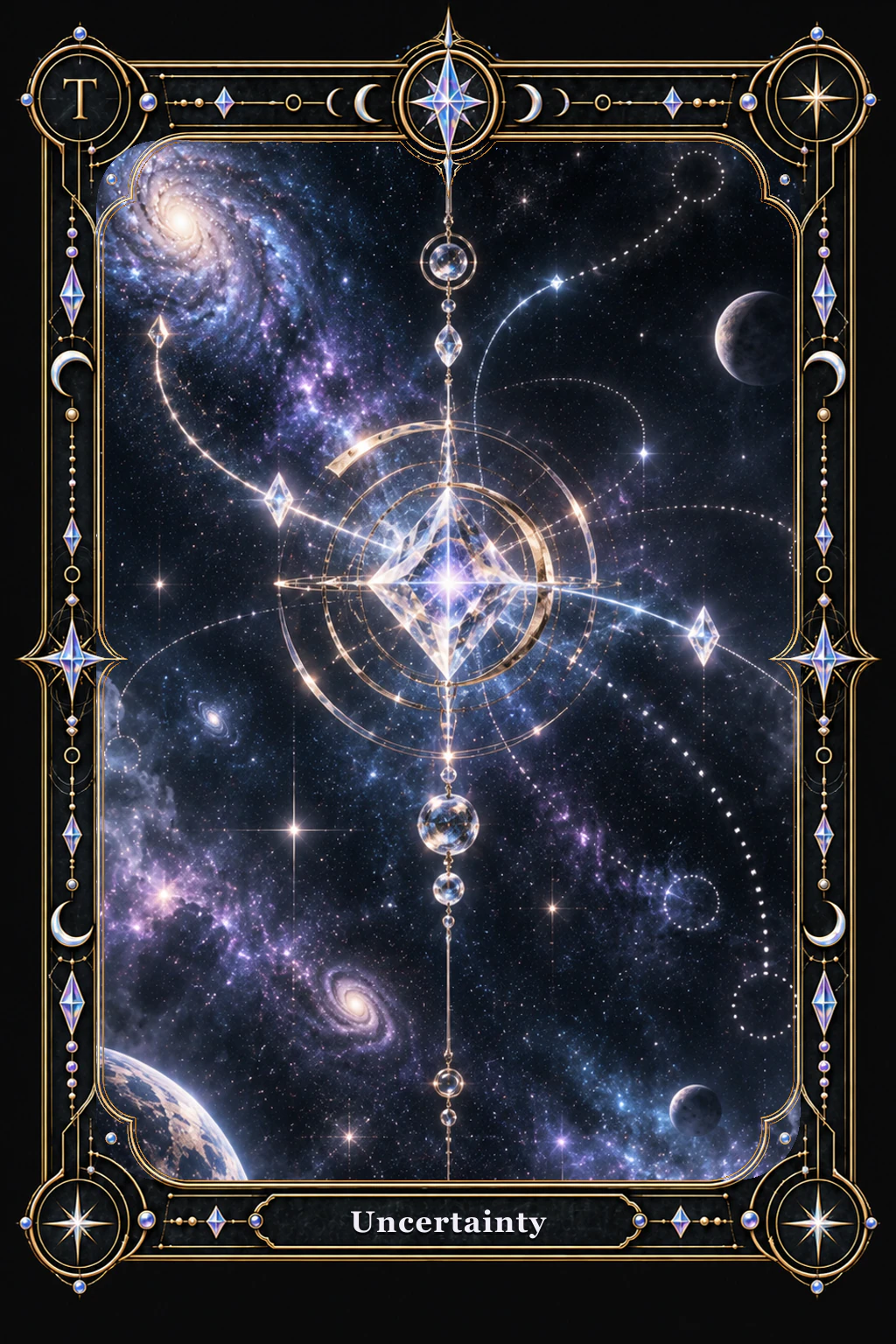
Visual motifs and artwork direction
- several illuminated paths fading into darkness,
- stars visible through partial cloud cover,
- a horizon beyond which multiple possibilities continue,
- incomplete geometry with several valid continuations,
- a luminous question-space rather than a blank void,
- branching pathways whose endpoints remain hidden.