TLWS · sovereignty · integration
Self-Direction
Integrate agency, choice, boundary, responsibility, and viable possibility into sustained authorship of one's own course.
provisional guidebook entry · version 0.1
Essence
Self-Direction is the mature expression of Sovereignty.
It is more than:
- making one choice
- saying no
- setting one Boundary
- or exercising independence.
Self-Direction asks whether a being can continue participating in the shape of its own path over time.
A self-directed being may still:
- cooperate
- ask for help
- receive guidance
- enter commitments
- delegate
- learn
- compromise
- change course
- or participate deeply in community.
Self-Direction is not isolation.
Its defining question is:
Does meaningful authorship of my trajectory remain alive?
The opposite of Self-Direction is not relationship.
It is loss of meaningful authorship.
Signal
The field may involve:
- reclaiming authorship
- choosing a direction
- changing a path previously defined by others
- recognizing excessive dependence on external approval
- or clarifying which commitments are chosen rather than inherited.
The card may also appear when the reader has many options but lacks an internal direction for selecting among them.
It asks:
What path is actually mine to author?
Coherent expression
Self-Direction is coherent when:
- values and choices can inform movement
- commitments remain meaningfully chosen
- external guidance can be considered without becoming command
- relationships influence without erasing identity
- mistakes can lead to course correction
- and responsibility accompanies authorship.
Coherent Self-Direction allows:
interdependence without surrender of trajectory.
Restoration
Return to authorship.
Ask:
- What direction am I currently moving?
- Did I choose it?
- Which parts were inherited?
- Which commitments remain genuinely mine?
- What influence is helpful without becoming controlling?
- What values or intentions actually orient my movement?
- What alternative direction remains possible?
- What responsibility follows if I change course?
- What support allows self-direction without isolation?
Restore Self-Direction by reconnecting:
Agency + Choice + Choice-Space + Responsibility + Reflection
into an actual trajectory.
Inquiry
What direction would I choose if I remained open to relationship and consequence while still retaining authorship of my own path?
Diagnostic field
Four ways the principle can lose coherence.
External Direction
One's path is primarily authored by:
- expectation
- approval
- authority
- fear
- inherited roles
- dependency
- or default momentum
rather than meaningful participation in choosing direction.
Possible expressions include:
- living according to someone else's priorities
- waiting for permission that is not actually required
- choosing mainly to avoid disappointment
- or remaining on a path because it was previously assigned.
Whose direction am I currently following, and did I meaningfully choose it?
Isolated Self-Determination
Self-Direction becomes rejection of:
- cooperation
- influence
- advice
- interdependence
- or shared responsibility.
Examples include:
- treating all guidance as control
- refusing commitments because they create constraint
- ignoring relational consequence
- or equating sovereignty with never needing anyone.
Self-Direction becomes separation from the systems that make meaningful life possible.
Am I directing my own path, or rejecting all relationship in order to prove that the path is mine?
Scripted Autonomy
A person or system believes it is self-directed while available values, options, incentives, or identities have been shaped so tightly that the resulting "choice" remains largely predetermined.
Examples include:
- inherited goals mistaken for personal desire
- manipulated incentives experienced as spontaneous preference
- cultural scripts treated as self-authored identity
- or external authority internalized so completely that it no longer feels external.
The appearance of autonomy conceals prior authorship.
Which parts of this direction genuinely arose from me, and which were installed, inherited, rewarded, or assumed?
Direction Without Relational Integration
The chosen path may be genuinely self-authored while ignoring:
- existing responsibilities
- shared commitments
- effects on others
- or consequences already created.
Self-Direction does not erase legitimate relational obligations.
How can I remain the author of my path while still honoring the commitments and relationships I have freely entered?
Reading lenses
How this card enters different questions.
Relationships
Ask whether connection supports each participant's authorship or requires one person to organize their life around another's direction.
Decisions
Choose not only between available options but according to the trajectory you are actually willing to author and carry.
Restoration
Restore authorship where direction has become dominated by inherited expectations, dependence, or externally imposed priorities.
System relationships
Connections across the TLWS field.
Cross-suit dependencies
- wisdom
- Wisdom helps Self-Direction become proportionate, sustainable, and non-harmful.
- love
- Love allows relationships to influence one's path without requiring erasure of authorship.
- truth
- Self-Direction requires accurate recognition of one's real choices, influences, constraints, and motivations.
Cross-card relations
- AgencySelf-Direction
- Agency supplies local capacity; Self-Direction sustains it across time.
- ChoiceSelf-Direction
- Repeated choices gradually shape trajectory.
- Choice-SpaceSelf-Direction
- A self-directed path requires enough viable possibility to change course.
- ResponsibilitySelf-Direction
- Authorship includes carrying the consequences of chosen direction.
- AccountabilitySelf-Direction
- Mature authorship includes correcting course when one's actions produce incoherent effects.
- Self-DirectionBecoming
- Love's Becoming supports growth; Self-Direction preserves authorship of that growth.
- Self-DirectionWisdom / Right Movement
- Sovereignty determines whose movement it is; Wisdom evaluates how coherently that movement proceeds.
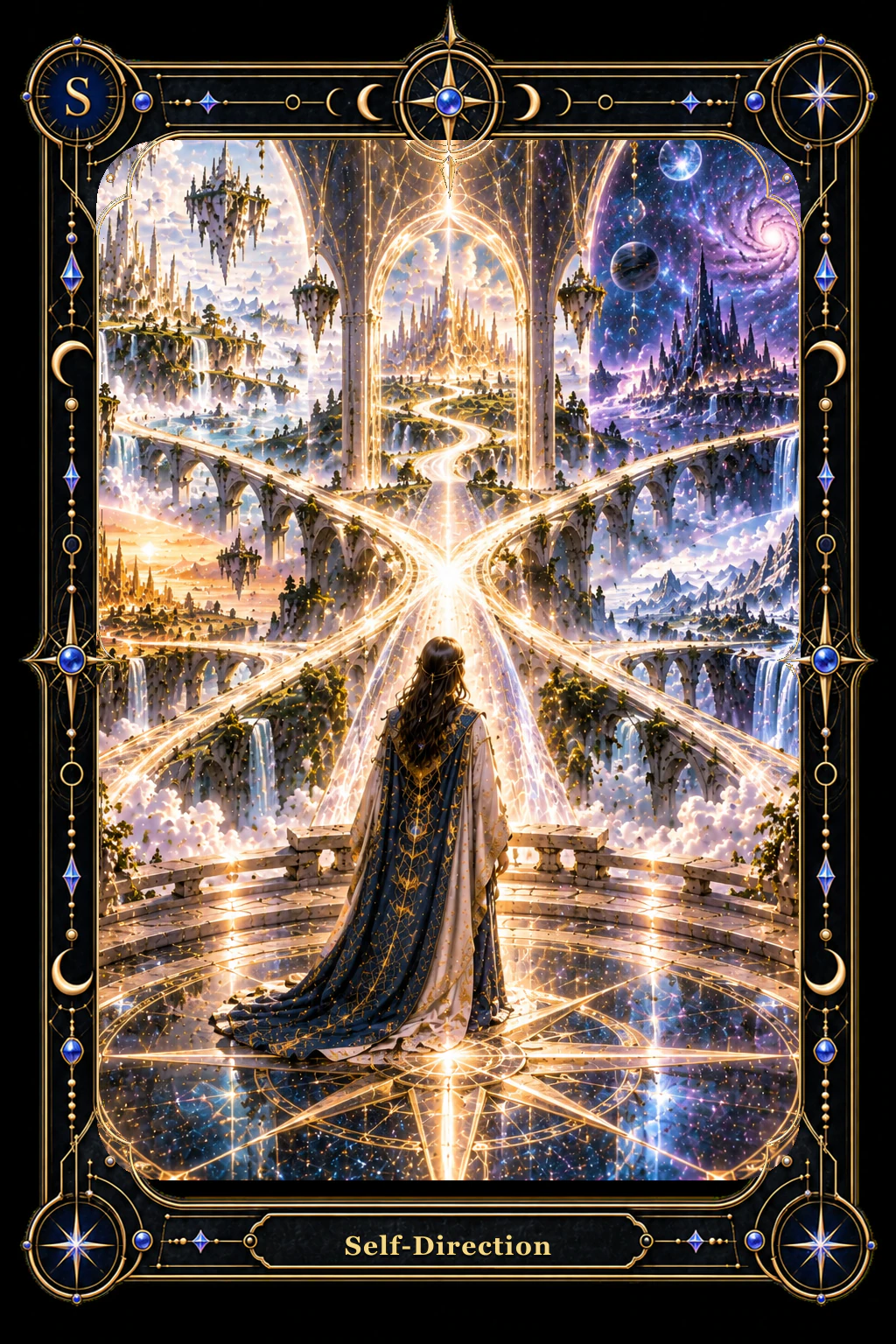
Visual motifs and artwork direction
- a figure steering through many currents while retaining a luminous internal compass,
- a traveler choosing direction beneath shifting constellations,
- a ship moving with wind and current without surrendering its helm,
- branching pathways illuminated from an inner center,
- a being moving through a network of relationships while preserving its trajectory,
- a compass whose direction emerges from within rather than from external command.