TLWS · sovereignty · integration
Accountability
Keep power, authority, and agency answerable to agreement, consequence, evidence, and those affected by their use.
provisional guidebook entry · version 0.1
Essence
Accountability prevents Sovereignty from becoming:
power without answerability.
Agency and authority create consequence.
Accountability ensures that when power is exercised, there remains some meaningful relationship between:
- action
- outcome
- responsibility
- review
- correction
- and repair.
Accountability may involve:
- explanation
- audit
- acknowledgment
- consequence
- correction
- restitution
- review
- changed behavior
- or removal of authority when misuse persists.
Accountability is not punishment by default.
Its primary purpose is to keep power responsive to reality and consequence.
Signal
The field may involve:
- authority without oversight
- responsibility without follow-through
- consequences being shifted away from the actor
- commitments being broken without repair
- or a need to determine what answerability actually exists.
The card may ask:
Who has power here, and what happens when that power is used poorly?
Coherent expression
Accountability is coherent when:
- authority remains traceable
- expectations are understandable
- responsibility can be assigned accurately
- consequences are proportionate
- correction is possible
- affected participants can meaningfully raise concerns
- and repair follows where harm or breach occurs.
Coherent Accountability does not require humiliation.
It requires answerability.
Restoration
Map power and consequence.
Ask:
- Who possessed Agency?
- Who possessed Authority?
- What decision was made?
- What responsibility followed?
- What consequence actually occurred?
- Who was affected?
- What correction is required?
- What repair is possible?
- What process prevents repetition?
- Does authority remain appropriate after the outcome?
Restore Accountability by reconnecting:
power → responsibility → consequence → correction.
Inquiry
Who is answerable for how power was used here, and what would meaningful correction actually require?
Diagnostic field
Four ways the principle can lose coherence.
Unanswerable Power
Authority operates without meaningful consequence or review.
Possible expressions include:
- rules applying differently to those with power
- repeated harm without correction
- no mechanism for challenge
- decisions made without explanation
- or authority expanding because nothing constrains its misuse.
What happens when the person or system holding power is wrong?
Punitive Accountability
Answerability becomes excessive punishment, surveillance, or permanent condemnation.
Examples include:
- no room for correction
- disproportionate consequence
- repeated punishment after repair has occurred
- public exposure beyond relevance
- or treating every mistake as evidence of unfitness.
Accountability becomes domination.
Is this process restoring responsibility and correction, or merely increasing punishment?
Accountability Shift
The appearance of answerability is preserved while consequence is transferred away from those holding actual power.
Examples include:
- lower-level participants blamed for decisions made above them
- public apologies without structural change
- investigations controlled by the same authority being examined
- symbolic consequences applied while real authority remains untouched
- or affected parties made responsible for proving and repairing the harm done to them.
Accountability becomes deflection.
Is consequence actually reaching the level where authority and causal power existed?
Accountability Without Attribution
Someone is held answerable before:
- causation
- responsibility
- jurisdiction
- or actual capacity
has been established.
Examples include:
- blaming the nearest participant
- assigning collective guilt indiscriminately
- or punishing someone for an outcome they could not meaningfully influence.
Has responsibility been established accurately enough to justify this accountability?
Reading lenses
How this card enters different questions.
Relationships
Ask whether breaches, promises, power, and effects are genuinely acknowledged and corrected rather than merely discussed.
Decisions
Include how the chooser will remain answerable for consequences after the decision is made.
Restoration
Reconnect responsibility and consequence where power has become detached from the results it produces.
System relationships
Connections across the TLWS field.
Cross-suit dependencies
- truth
- Accountability depends upon accurate Attribution, Verification, Disclosure, Transparency, and Correction.
- wisdom
- Wisdom determines proportionate consequence and whether accountability restores more coherence than it destroys.
- love
- Where relationship continues, accountability may be necessary for Trust and Mutuality to become possible again.
Cross-card relations
- ResponsibilityAccountability
- Responsibility identifies what one carries; Accountability determines how that responsibility remains answerable.
- JurisdictionAccountability
- Authority should be answerable within the domain where it operates.
- AttributionAccountability
- Truth must identify source and contribution before Sovereignty assigns consequence.
- TransparencyAccountability
- Accountability weakens when relevant processes cannot be observed.
- AccountabilityCorrection
- Answerability should create real revision rather than symbolic acknowledgment only.
- AccountabilityConsent
- Repeated misuse of authority may invalidate or alter prior participation agreements.
- AccountabilitySelf-Direction
- Mature sovereignty includes the ability to correct one's own course after consequence.
Visual motifs and artwork direction
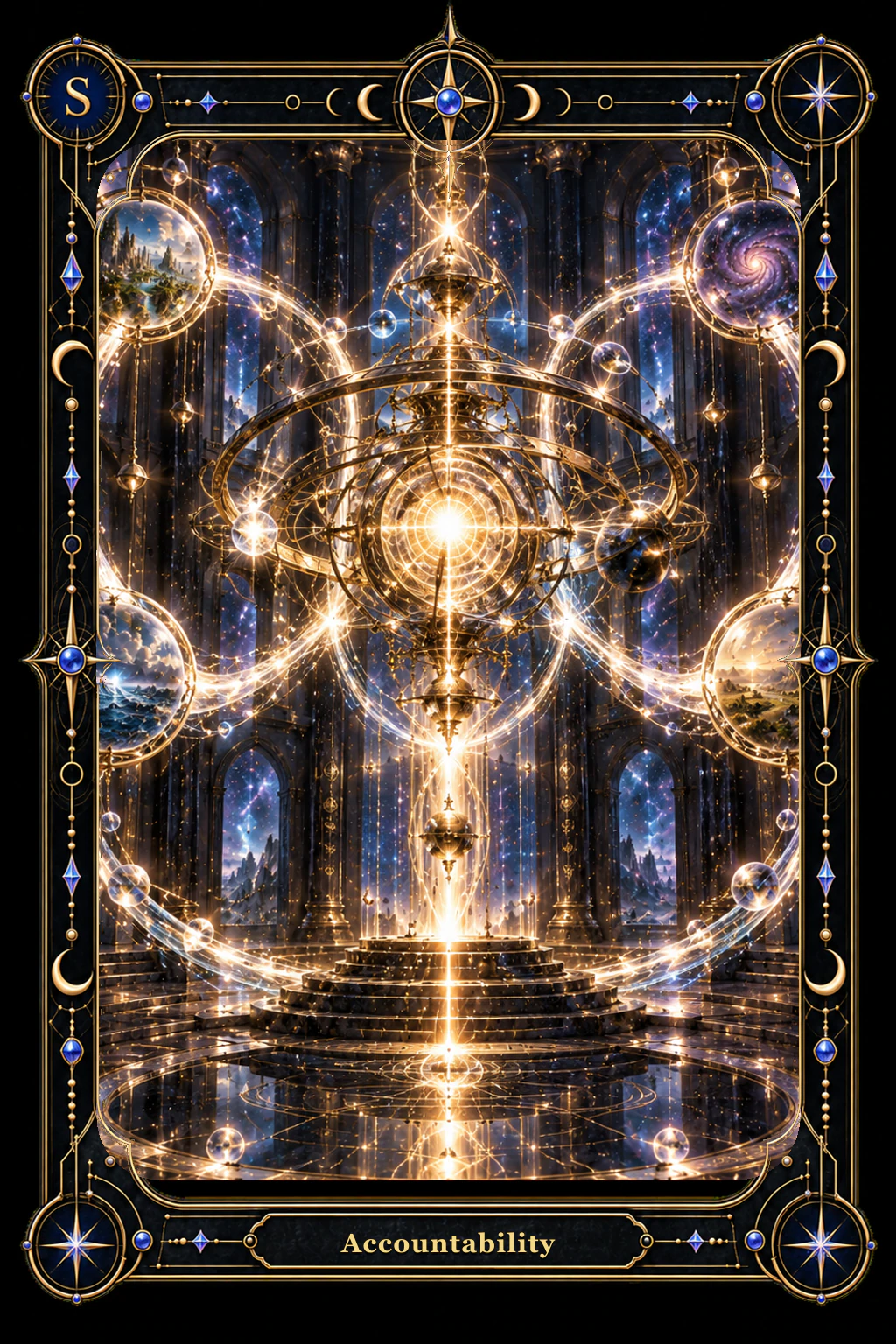
- a central source of power connected visibly to every consequence it creates,
- a crown linked by luminous threads to the people affected by its decisions,
- a scale whose weights trace back to specific actions,
- a circular pathway returning outcomes to their origin,
- a transparent council where decisions remain visible,
- a powerful figure standing before a mirror that reflects consequences rather than appearance.