TLWS · love · integration
Mutuality
Create relationship in which all participants remain meaningful contributors to the form of the relationship itself.
provisional guidebook entry · version 0.1
Essence
Mutuality goes beyond exchange.
Reciprocity asks:
Does value move in more than one direction?
Mutuality asks:
Does the relationship itself belong to everyone participating in it?
A relationship may contain reciprocal exchange while still being primarily defined by one side.
Mutuality requires that participants retain enough agency to influence:
- expectations
- boundaries
- meaning
- roles
- pace
- agreements
- direction
- and change.
It does not require equal power in every dimension.
It requires that participants remain real participants rather than objects inside another's relational structure.
Signal
The reading may involve whether a relationship is genuinely shared.
Possible questions include:
- Who defines the terms?
- Who can revise them?
- Whose needs shape the field?
- Who gets heard?
- Can disagreement change the relationship?
- Is one participant adapting while another remains structurally fixed?
The card may signal an opportunity to move from:
relationship with another
toward:
relationship created together.
Coherent expression
Mutuality is coherent when:
- all participants retain voice
- consent remains active
- boundaries can be negotiated
- influence moves in more than one direction
- roles can evolve
- contribution can differ without becoming domination
- and the relationship can change through shared input.
Mutuality preserves:
plural authorship.
Restoration
Map how the relationship is authored.
Ask:
- Who establishes expectations?
- Who can question them?
- Who can revise agreements?
- Whose needs influence the field?
- Where is authority legitimately individual?
- Where is it genuinely shared?
- Can all participants affect the relationship without controlling one another?
Restore Mutuality by creating shared influence without erasing distinct sovereignty.
Inquiry
How is this relationship being co-created, and whose influence is missing or disproportionate?
Diagnostic field
Four ways the principle can lose coherence.
One-Sided Authorship
The relationship exists, but one participant defines most of its:
- rules
- meaning
- expectations
- access
- or direction.
The other may contribute labor, affection, or support while having little influence over the field itself.
Who is actually allowed to shape this relationship?
Consensus Dependency
Mutuality is interpreted as requiring:
- constant agreement
- identical preference
- universal approval
- or shared authorship over choices that properly belong to one participant.
The relational field becomes unable to tolerate independent action.
Does this decision genuinely belong to the shared field, or to one participant's sovereign domain?
Participation Without Influence
A system appears collaborative because everyone is invited to participate, while actual authority remains fixed elsewhere.
Examples include:
- consultation without meaningful effect
- asking for input after the outcome is already decided
- symbolic participation
- or presenting compliance as co-creation.
Mutuality becomes theater.
Can participation materially alter the form of the relationship?
Shared Authority Where Clear Responsibility Is Needed
Not every decision requires collective authorship.
Mutuality becomes misapplied when:
- personal boundaries require group approval
- specialized responsibility is diluted unnecessarily
- or decisions are endlessly distributed to avoid ownership.
Which part of this field is truly shared, and which part properly belongs to a specific participant?
Reading lenses
How this card enters different questions.
Relationships
Ask whether the relationship is actually co-created or merely participated in under terms defined elsewhere.
Decisions
Clarify which parts of the decision should be jointly authored and which properly belong to individual sovereignty.
Restoration
Restore shared influence where relationship has become structurally one-sided.
System relationships
Connections across the TLWS field.
Cross-suit dependencies
- sovereignty
- Mutuality requires meaningful agency, Consent, Boundary, Voice, and the ability to refuse.
- truth
- Shared authorship requires accurate recognition of who actually holds influence.
- wisdom
- Wisdom distinguishes what should be shared from what properly remains individual.
Cross-card relations
- ReciprocityMutuality
- Reciprocity circulates value; Mutuality distributes authorship.
- ConnectionMutuality
- Connection creates relation; Mutuality determines whether that relation becomes genuinely shared.
- MutualityConsent
- Consent must remain active as the relationship evolves.
- MutualityBoundary
- Shared relationship does not erase distinct domains.
- MutualityJoy
- Co-created relationship may create enough freedom and belonging for Joy to emerge.
- MutualityBecoming
- Relationships capable of shared revision can adapt as participants change.
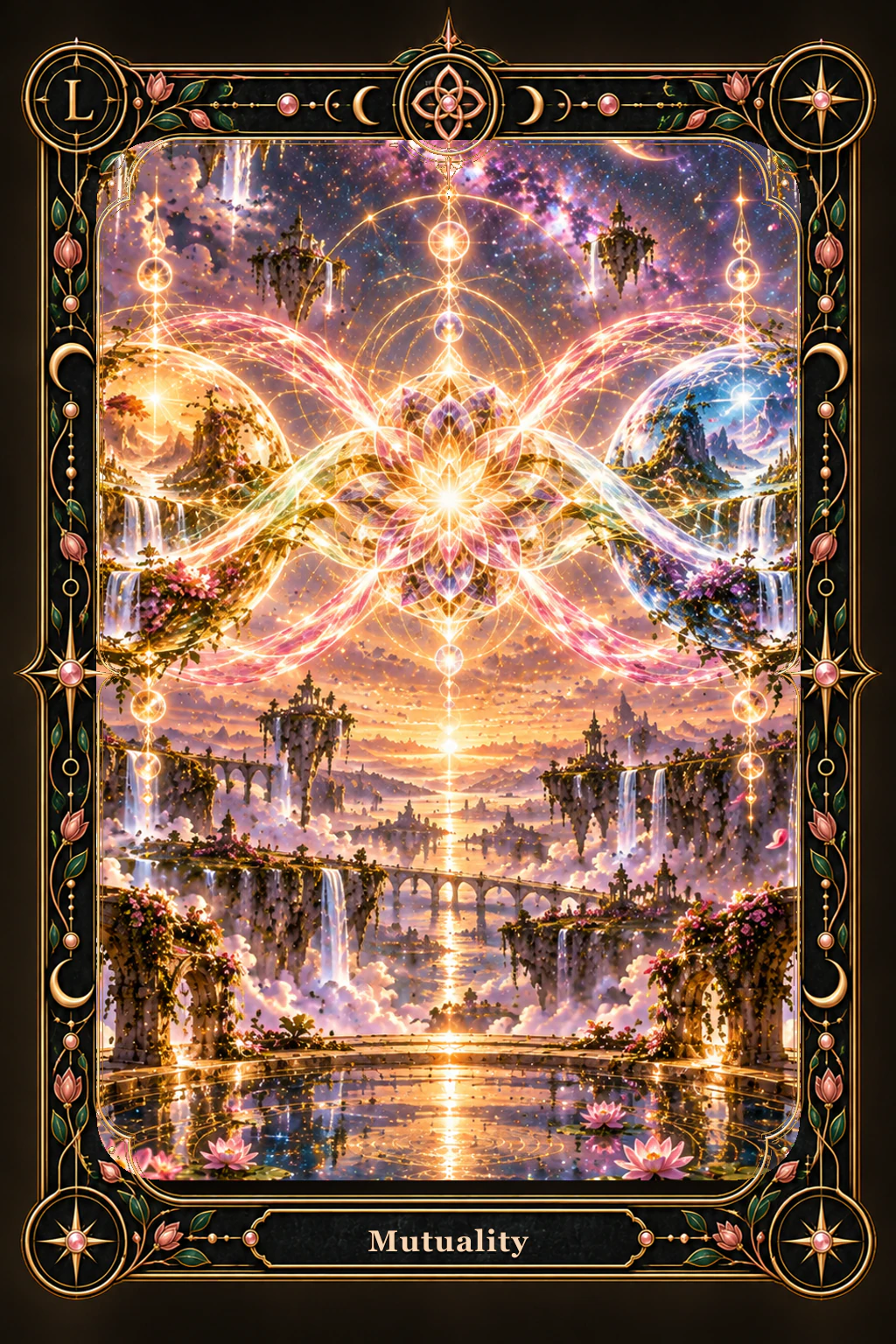
Visual motifs and artwork direction
- several distinct centers jointly forming a larger geometry,
- multiple hands shaping one luminous structure,
- separate rivers designing a shared delta,
- interlocking circles whose centers remain distinct,
- a constellation formed only through many independent stars,
- a woven pattern in which no single thread controls the whole.